01 - Wenqi Huang, Mostafa Akbari - theater in Utopia
Date : 1-15-2018
Mostafa Akbari - Wenqi Huang
Theater in Utopia


Flying robots :
https://www.youtube.com/watch?v=cEKCcs8-O4A
Hyper Cell :
1.
https://www.forbes.com/sites/bernardmarr/2016/06/30/are-we-headed-for-automated-luxury-communism/#5d96b8a837e3
2.
https://www.thestranger.com/blogs/slog/2015/03/20/21933062/what-is-luxury-communism


Future robotic toys :
Airbnb in future :
Small robots capable of big things - jumping :
Swarm robots - harvard :
AAdrl - self assembly fracture :
Self Assembly wire - Stanford :
Cell robot - future gadget :
Our answer to the questions :
Q1:1: A brief history of contemporary
automation
(Inventing the
Future, fully automated luxury communism)
Definition:
Automation can
be defined as the technology by which a process or procedure is performed
without human assistance.[1]
In other
words, Automation[2] or automatic
control, is the use of various control
systems for operating
equipment such as machinery, processes in factories, boilers and heat treating
ovens, switching on telephone networks, steering and stabilization of ships,
aircraft and other applications and vehicles with minimal or reduced human
intervention, with some processes have been completely automated.
History:
The earliest feedback control mechanism was the
water clock invented by Greek engineer Ctesibius (285–222 BC).[10] In
the modern era, the thermostat invented in 1620 by the Dutch
scientist Cornelius Drebbel. (Note: Early thermostats were temperature
regulators or controllers rather than the on-off mechanisms common in household
appliances.) Another control
mechanism was used to tent the sails of windmills. It was patented by Edmund
Lee in 1745.[11] Also in 1745, Jacques de Vaucanson invented the first automated loom.
In 1771 Richard
Arkwright invented the
first fully automated spinning mill driven by water power, known at the time as
the water frame.[12] An
automatic flour mill was developed by Oliver
Evans in 1785,
making it the first completely automated industrial process.[13][14]
The centrifugal governor, which was invented by Christian
Huygens in the
seventeenth century, was used to adjust the gap between millstones.[15][16][17] Another
centrifugal governor was used by a Mr. Bunce of England in 1784 as part of a
model steam crane.[18][19] The centrifugal governor was adopted by
James Watt for use on a steam engine in 1788 after Watt’s partner Boulton saw
one at a flour mill Boulton
& Watt were building.[11]
The governor could
not actually hold a set speed; the engine would assume a new constant speed in
response to load changes. The governor was able to handle smaller variations
such as those caused by fluctuating heat load to the boiler. Also, there was a
tendency for oscillation whenever there was a speed change. As a consequence,
engines equipped with this governor were not suitable for operations requiring
constant speed, such as cotton spinning.[11]
Several improvements
to the governor, plus improvements to valve cut-off timing on the steam engine,
made the engine suitable for most industrial uses before the end of the 19th
century. Advances in the steam engine stayed well ahead of science, both
thermodynamics and control
theory.[11]
The governor
received relatively little scientific attention until James Clerk Maxwell published a paper that established the
beginning of a theoretical basis for understanding control theory. Development
of the electronic amplifier during the 1920s, which was important for long
distance telephony, required a higher signal to noise ratio, which was solved
by negative feedback noise cancellation. This and other telephony applications
contributed to control theory. In the 1940s and 1950s, German
mathematician Irmgard Flugge-Lotz developed the theory of discontinuous
automatic controls, which found military applications during the Second
World War to fire control systems and aircraft navigation
systems.[7]
Relay logic was introduced with factory electrification, which underwent rapid adaption from 1900
though the 1920s. Central electric power stations were also undergoing rapid
growth and operation of new high pressure boilers, steam turbines and
electrical substations created a large demand for instruments and controls.
Central control rooms became common in the 1920s, but as late as the early
1930s, most process control was on-off. Operators typically monitored charts
drawn by recorders that plotted data from instruments. To make corrections, operators
manually opened or closed valves or turned switches on or off. Control rooms
also used color coded lights to send signals to workers in the plant to
manually make certain changes.[20]
Controllers, which were able to make calculated
changes in response to deviations from a set point rather than on-off control,
began being introduced the 1930s. Controllers allowed
manufacturing to continue showing productivity gains to offset the declining
influence of factory electrification.[21]
Factory productivity
was greatly increased by electrification in the 1920s. Manufacturing
productivity growth fell from 5.2%/yr 1919-29 to 2.76%/yr 1929-41. Field notes
that spending on non-medical instruments increased significantly from 1929–33
and remained strong thereafter.
In 1959 Texaco’s Port
Arthur refinery became the first chemical plant to use digital
control.[22] Conversion
of factories to digital control began to spread rapidly in the 1970s as the
price of computer hardware fell.
The automatic
telephone switchboard was introduced in 1892 along with dial telephones.[23] By
1929, 31.9% of the Bell system was automatic. Automatic telephone switching
originally used vacuum tube amplifiers and electro-mechanical switches, which
consumed a large amount of electricity. Call volume eventually grew so fast
that it was feared the telephone system would consume all electricity
production, prompting Bell Labs to begin research on the transistor.[24]
The logic performed
by telephone switching relays was the inspiration for the digital computer. The first commercially successful
glass bottle blowing machine was an automatic model introduced in 1905.[25] The
machine, operated by a two-man crew working 12-hour shifts, could produce
17,280 bottles in 24 hours, compared to 2,880 bottles made by a crew of six men
and boys working in a shop for a day. The cost of making bottles by machine was
10 to 12 cents per gross compared to $1.80 per gross by the manual glassblowers
and helpers.
Sectional electric drives were developed using
control theory. Sectional electric drives are used on different sections of a
machine where a precise differential must be maintained between the sections. In steel rolling, the metal elongates as it
passes through pairs of rollers, which must run at successively faster speeds.
In paper making the paper sheet shrinks as it passes around steam heated drying
arranged in groups, which must run at successively slower speeds. The first
application of a sectional electric drive was on a paper machine in 1919.[26] One
of the most important developments in the steel industry during the 20th
century was continuous wide strip rolling, developed by Armco in 1928.[27]
Before automation
many chemicals were made in batches. In 1930, with the widespread use of
instruments and the emerging use of controllers, the founder of Dow Chemical
Co. was advocating continuous production.[28]
Self-acting machine tools that displaced hand dexterity so they could be
operated by boys and unskilled laborers were developed by James Nasmyth in the 1840s.[29] Machine tools were automated with Numerical control (NC) using punched paper tape in the 1950s. This soon evolved
into computerized numerical control (CNC).
Today extensive automation is practiced in
practically every type of manufacturing and assembly process. Some of the larger processes include
electrical power generation, oil refining, chemicals, steel mills, plastics,
cement plants, fertilizer plants, pulp and paper mills, automobile and truck
assembly, aircraft production, glass manufacturing, natural gas separation
plants, food and beverage processing, canning and bottling and manufacture of
various kinds of parts. Robots are especially useful in hazardous applications
like automobile spray painting. Robots are also used to assemble electronic
circuit boards. Automotive welding is done with robots and automatic welders
are used in applications like pipelines.
Automated Luxury Communism:
Definition: The Guardian recently posted a piece about a movement that sees in the
robotization of the factory, the self-checkout machines at retail stores (these
are not even robots), and
Amazon's coming delivery drones, a post-work society where luxury is finally democratized. They
call this techno-utopia: luxury communism. It's a world where machines do all of the work and, as a consequence,
everyone has lots of free time.
Q2: Automation and utopia
(The re-appropriation of the architectural
utopia)
Video:
Article:
1.
https://www.forbes.com/sites/bernardmarr/2016/06/30/are-we-headed-for-automated-luxury-communism/#5d96b8a837e3
2.
https://www.thestranger.com/blogs/slog/2015/03/20/21933062/what-is-luxury-communism
How
will autonomous vehicles change the way architects think about cities?
How will autonomous vehicles change the way architects think?
Pictured here: FXFOWLE has proposed their own system of interchangeable,
plug-and-play
City planning operates
on decades-long cycles, while infrastructure is typically built out using
forecasts that extend current trends. If self-driving vehicles are
poised to deliver the revolution in urban transportation that Silicon Valley
has been promising, how should urban infrastructure accommodate them? With less
parking spots needed, how can designers effectively reclaim this urban
space? Anticipating the Driverless City, a recent conference hosted by the AIA New York (AIANY),
brought together Uber executives,
planners, architects, and policymakers in pursuit of a holistic approach to
adapting to life with autonomous vehicles.
Speakers acknowledged
the same general themes over and over again, despite their differing
backgrounds. With self-driving cars possibly arriving in New York City by early 2018 and
real-world tests already happening in other cities, one of
the most discussed topics was the need to plan for an autonomous future as soon
as possible.
Nico Larco,
co-director of the Sustainable Cities Initiative, stressed that “planners think
in 30-year increments, and autonomous vehicles are already hitting the streets
today. Urban planners should be terrified.”
Autonomous vehicles
will touch on every facet of urban life, from water management through the
reduction of impermeable roads, to electrical grid infrastructure, and
drastically reshape the economy. Larco, and many others throughout the
event spoke of the need for government to begin working with planners and
policymakers to redesign cities from the ground-up.

Waymo
is just one company pursuing self-driving car technology. Google, Tesla, Uber,
Lyft and others are all racing to bring their cars to market. (Grendelkhan/Wikimedia)
Leaning on a “people,
places, policy” framework is a good starting point, as architects and planners
can strategize about how autonomous vehicles could possibly affect each of the
three. Sam Schwartz, former NYC Traffic Commissioner and founder of transit
planning firm Sam Schwartz Engineering, described how a future society with
self-driving cars could tilt towards “good,” “bad,” or “ugly” outcomes.
The ideal scenario
would be one where the use of autonomous vehicles has encouraged mass transportation
use, acting to move commuters to and from high-capacity transit corridors.
Because self-driving cars can pack tighter and don’t need to park, streets
would be narrowed and the extra space converted to public parkland. Conversely,
in a world where autonomous vehicles are owned only by individuals, pedestrians
might be walled off from the street, and our roads might be more packed than
ever.
According to Jeff
Tumlin, principal and director of strategy at Nelson/Nygaard, the way we think
about self-driving cars directly stems from concepts first presented at the
1939 World’s Fair. Nearly 80 years later, architects and planners wanting to
design for a future with self-driving cars, busses, and trains, will need to go
beyond simply extending our current car culture.
http://www.e-flux.com/architecture/artificial-labor/140671/autonomous-architectural-robots/
Artificial Labor
Axel Kilian
Autonomous Architectural Robots
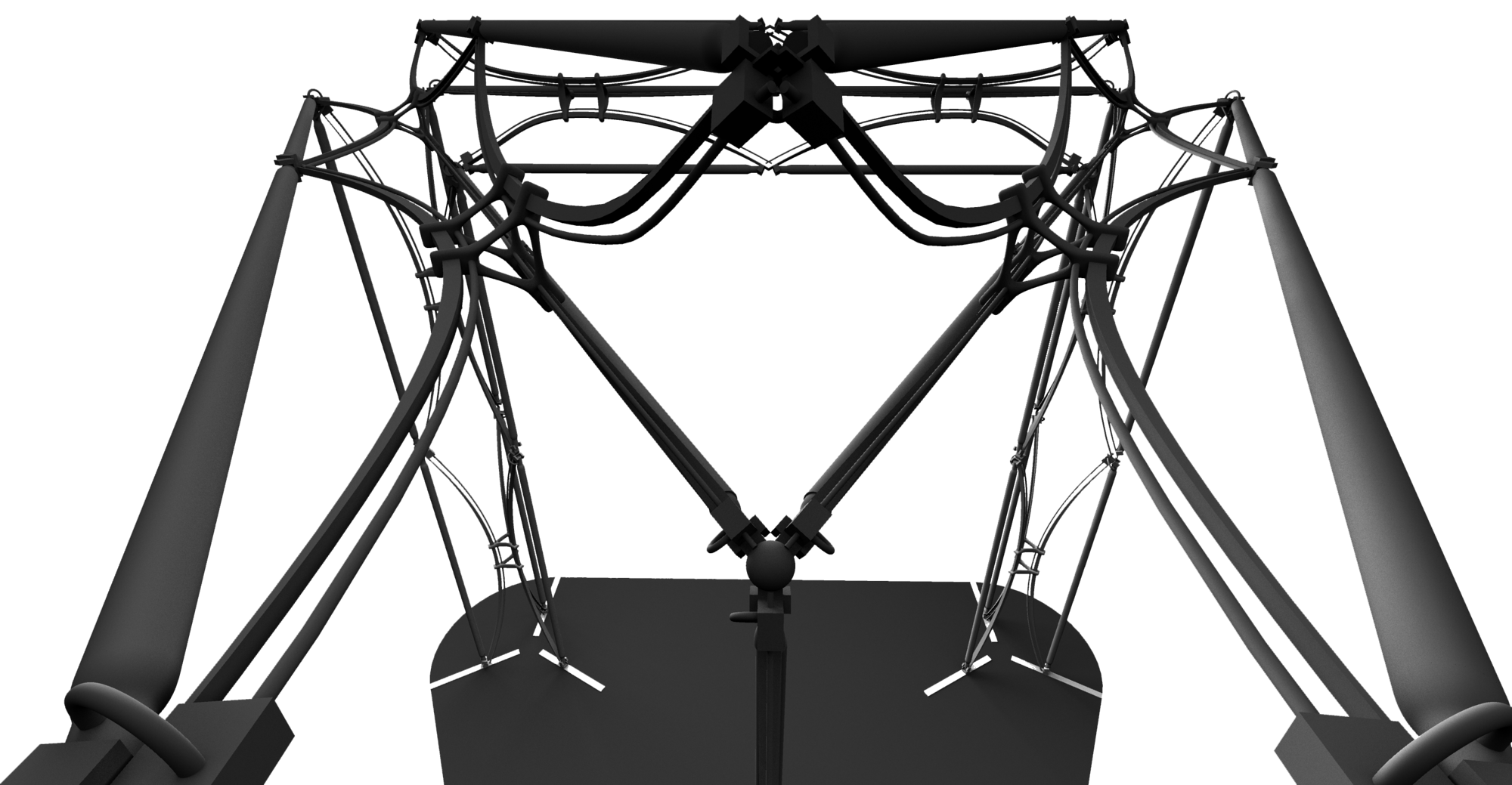
Rendering of
Axel Kilian, Flexing Room, 2017.
Robotics has an anthropomorphic obsession. We build robots in
the image of ourselves, but think of them more as objects that manipulate other
objects. In a utopian scenario, these anthropomorphic robots take over
strenuous, inhuman labor to free humans for higher tasks and leisure, whereas
in a dystopian one, they become a threat to humans, taking away their
livelihood, outpacing and outdoing them, step by step, in every area of human
ability and labor, both physical and mental.
An alternative
to this projected threat lies in the development of domain specific robotics,
such as architectural robotics at the scale of buildings. This is a reality in
which the focus of robotics is no longer solely on the materiality of the
object, but rather on techniques for manipulating immaterial patterns of
spatial inhabitation. Further change comes with the shift of complexity from
mechanical towards algorithmic and machine-learning. Shifting complexity from
the level of the physical machine to the level of control allows for the
integration of a much more heterogeneous set of controls at multiple scales.
Complexity
itself resists design in its ever-evolving and emergent configurations, and
quickly renders any attempt to resolve it obsolete. Yet with the open-ended
possibilities emerging from the fusion of adaptive computation and the physical
environment, design does not lock down solutions, but rather works at a
systemic level to invent novel ways of using pre-existing and newly developed
physical systems. Control can evolve by linking the physical hardware of
buildings to continuously evolving behavior with sensor inputs.
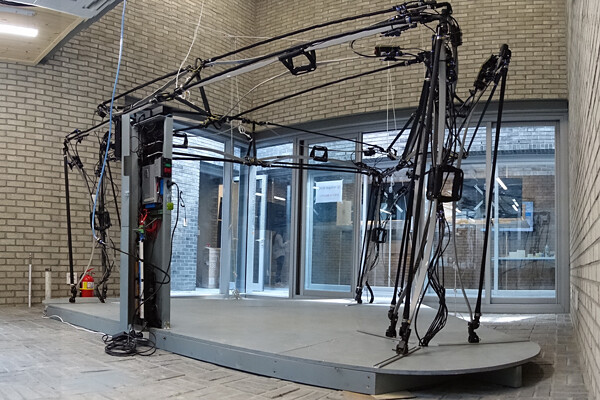
Installation
of Flexing Room at the Seoul Biennale of Architecture
and Urbanism 2017.
Take, for example, a standard mechanical forced-air ventilation
system that manipulates an isolated interior air volume to maintain constant
temperature by reading a network of thermostats. This mechanical, analog form
of computation is engineered into the system’s physical structure, making it
both robust and generic, but also limiting it to this single purpose.
Conversely, if actuators are placed on all operable elements such as doors and
windows of a building, supervised machine learning could potentially lead to
the discovery of new configurations of the building's architectural apertures
for ventilation. The combination of physical and digital computation in
building systems effectively turns architecture into a form of embodied
computation. Design can thus continue to operate at a systemic level throughout
the lifetime of a building, discovering emergent and useful ways to use
pre-existing physical systems.
Humans are always in a spatially mediated relation buildings.
Explicitly conceiving of buildings as environmental modulators could extend
control from air to space itself, differentiating social scenarios and shaping
collective social interaction. If the focus of architecture shifts from
passively housing human actions towards enacting spatial agendas through
buildings, an autonomous architecture may emerge.1 Shying away from the highly
loaded and burdened significance “autonomy” has carried in architectural
discourse since the 1970s, I propose to understand the term as it is used in
the contemporary context of technology, such as in "autonomous cars"
that acquire—and require—a degree of independence in decision making through
algorithmic design and machine learning. Automation is not equal to autonomy,
and autonomous machines rely on automatic processes in order to execute their
agenda. But while an automatic system’s responses are known and fixed, an
autonomous system is open-ended and independent in its self-governing decision
making process. As degrees of freedom increase and architectural and urban
scenarios get more complex, autonomy cannot stay confined to the scale of the
object.
When architecture
becomes robotic, its autonomy means that the design process must extend beyond
schematics, design development, and construction, and into the lifespan of the
building, becoming a learning process in the context of its environment. Design
is therefore not to be understood as an isolated process at the beginning of a
sequence that entails fabrication and inhabitation, but rather treated as one
continuous process, linking the design process with the process of use. The
term “embodied computation” stands for the expansion of computation as an
abstract, predominantly computational process into a hybrid
physical-computational construct. Computation needs to break out of the
limitations of simply describing the object and reach into the realm of
lived-in architecture, thus enabling autonomous architectural robotics.
"A day in
the life of Ada"
Precedents in architectural robotics range from the visions of
Cedric Price’s Fun Palace to contemporary experiments of the Hyperbody Group at
TU Delft, among others.2 One important reference with a strong emphasis on AI-based
human-building interaction is the ADA intelligent room project
from 2002 by the Institute of Neuroinformatics, ETH, Zurich, which exhibited
the beginnings of autonomy by shaping people’s behavior during their visit to
the Expo.3 The goal today is to push beyond interactivity and develop
architecture as an autonomous agent that actively shapes human behavior.
In contrast to the dominant research focus in architectural
robotics today on construction automation through industrial robot arms,
embodied computation approaches architecture itself as a robotic entity for
experimentation. One example, The Bowtower, is an
experimental prototype that uses its physical structure to solve a mathematical
function with six parameters, where the incline angle of the tower is the
function return value.4 The six parameters are the different air pressures in the
actuators, which cause them to contract and lean the tower. To level the tower,
a search algorithm is run to find a functional minimum by sequentially running
different sets of air pressures on the tower and monitoring the angle return,
driving it towards zero degrees. The control of the tower’s behavior is based
solely on feedback through the physical structure and not on a computational
simulation. The absence of a simulation model makes the tower’s control robust
against unpredictable changes such as defects in the structure or human
intervention. Without a codependent simulation and structure link that could get
out of sync, the changes are simply compensated through sensor feedback. This
concept has been expanded to a 36-actuator structure the size of a small room
in the Flexing Room, a skeletal enclosure that counts the
presence of people with a series of postures it strikes over time. The simple
leaning angle of the tower is replaced with a rudimentary form of social
feedback based on the occupation of the room. The robot has turned from an
object into enclosure.
In order to speculate about the potential of autonomous
architectural robotics, we must consider what buildings might be able to
perceive. Towards these ends we can look to Deb Roy’s 2013 study of his child’s
language development.5 Roy, director of the MIT Media Lab's Laboratory for Social
Machines, used overhead cameras to record and map all sounds from his family’s
domestic environment during the first years of their child’s development. The
study allowed for the precise tracing and identification of every utterance
spoken in both space and time. The study revealed the spatial clustering of
certain words, such the word “water” in the architectural context of the
kitchen. While analysis only happened after data collection had concluded, it
is fascinating to think about the possibility of architecture responding based
on an active understanding of how the floor plan and program shapes
inhabitants’ experiences.
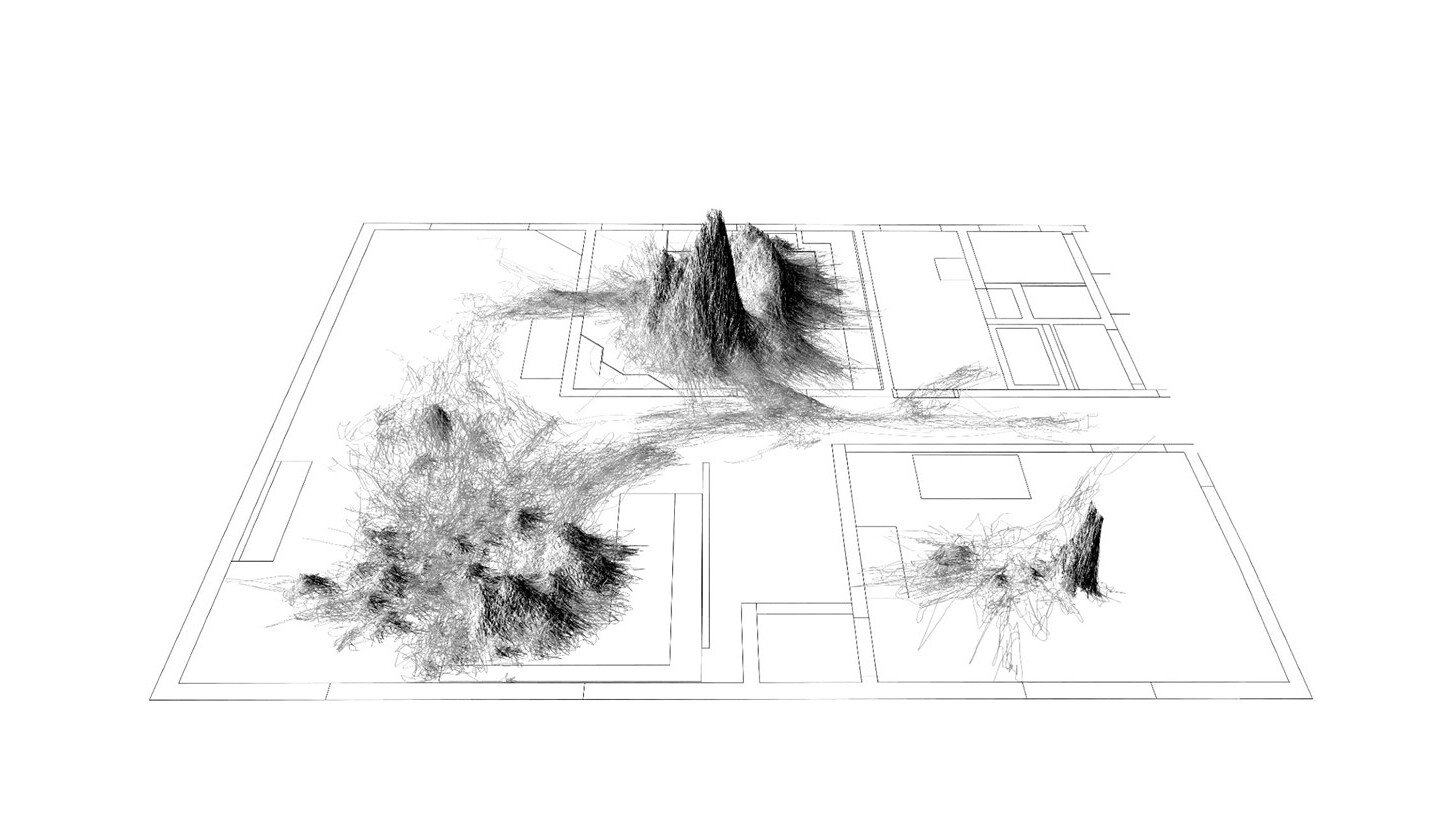
A “wordscape”
showing the birth of a word by mapping the data related to every utterance
of the word “water” in Deb Roy’s home. Image: Philip DeCamp/Deb Roy.
The fine granularity of Roy's spatial tracking within each room
and time, combined with situated acoustic recordings, is a reminder of how
simplistic the current accessory-based automation of private homes is.
Networked virtual assistants such as Alexa and Google Home occupy the acoustic
interface spectrum with speech-driven human-artificial intelligence
communication in millions of households today, and developments for their
integration into other domestic control systems are well underway. While
fascinating on the level of consumer products, its development is not one that
is driven by any notion of architectural potential or by engaging the spatial
dimension of built form. This form of domestic automation is limited to the
retrofitting of an assumed, generic space, and ignores the subtle compositional
and proportional variations that inherently dwell within architecture. While
the Nest Thermostat is more conceptually powerful in how it learns from the
user’s behaviors over time, it has yet to become holistically integrated into
the idea of architecture itself. Yet with the iRobot Company, makers of the
Roomba vacuums, proposing to sell automatically-generated floor plans of its
user’s homes to home automation firms like Google or Amazon, efforts to
integrate these consumer products more precisely into architectural contexts
are emerging.6
Despite
speech-based advances, man-machine interaction is still dominated by
screen-based interfaces. But the idea of robots as buildings, or buildings as
robots, offers the possibility of using space itself as an interface for
objects that are easily tens or even hundreds of times larger than the human
body and defy the simple object-to-object interface paradigm. Architecture
operates at a scale at which there would rarely ever be a one-on-one
interaction between human and architectural robot through a single interface.
Instead, an autonomous architectural robotics potentiates innumerable,
concurrent, and disparate human-robot interactions all with the same machine:
the building. Within this ecology of exchange, merely being situated in space
becomes a form of expression.
If we assume
our social media activity reveals much about ourselves, the next frontier is
that of the spatial resolution of inhabitation. It is crucial that architects
shape this development with architectural sensibilities and a critical stance
to preserve the autonomy of architecture both in a technological sense and also
in the sense of resisting the outright exploitation of architectural space for
commercial interests. Architectural robots can vastly expand the reach of
architectural design.
×
Artificial Labor is collaborative project
between e-flux Architecture and MAK Wien within the context of the VIENNA
BIENNALE 2017.
Axel Kilian is
Assistant Professor at the Princeton University School of Architecture, where
he started the research area of Embodied Computation, and jointly developed the
new Embodied Computation Lab that opened in Spring, 2017.


Comments
Post a Comment